How I Use the Garden to Help My Child Self-Soothe
There are days when emotions feel big.
As the mother of a child with autism and sensory processing challenges, I've learned that sometimes my son “Logo” needs a little extra time, space, and support to work through those big feelings.
Over the years, I've discovered one place that often helps us reset: The garden. When Logo is upset, overwhelmed, or having a difficult moment, sometimes we head outside. There isn't always a big plan. I don't hand him a worksheet or tell him why we should go outside. We simply go into the garden and I let him explore. He walks (stims) along the paths. He looks at the flowers. He checks to see what has changed since the last time we were outside. Sometimes he stops to look at an insect. Sometimes he touches a plant or watches the grasses move in the breeze.
And then there are the cucumbers.
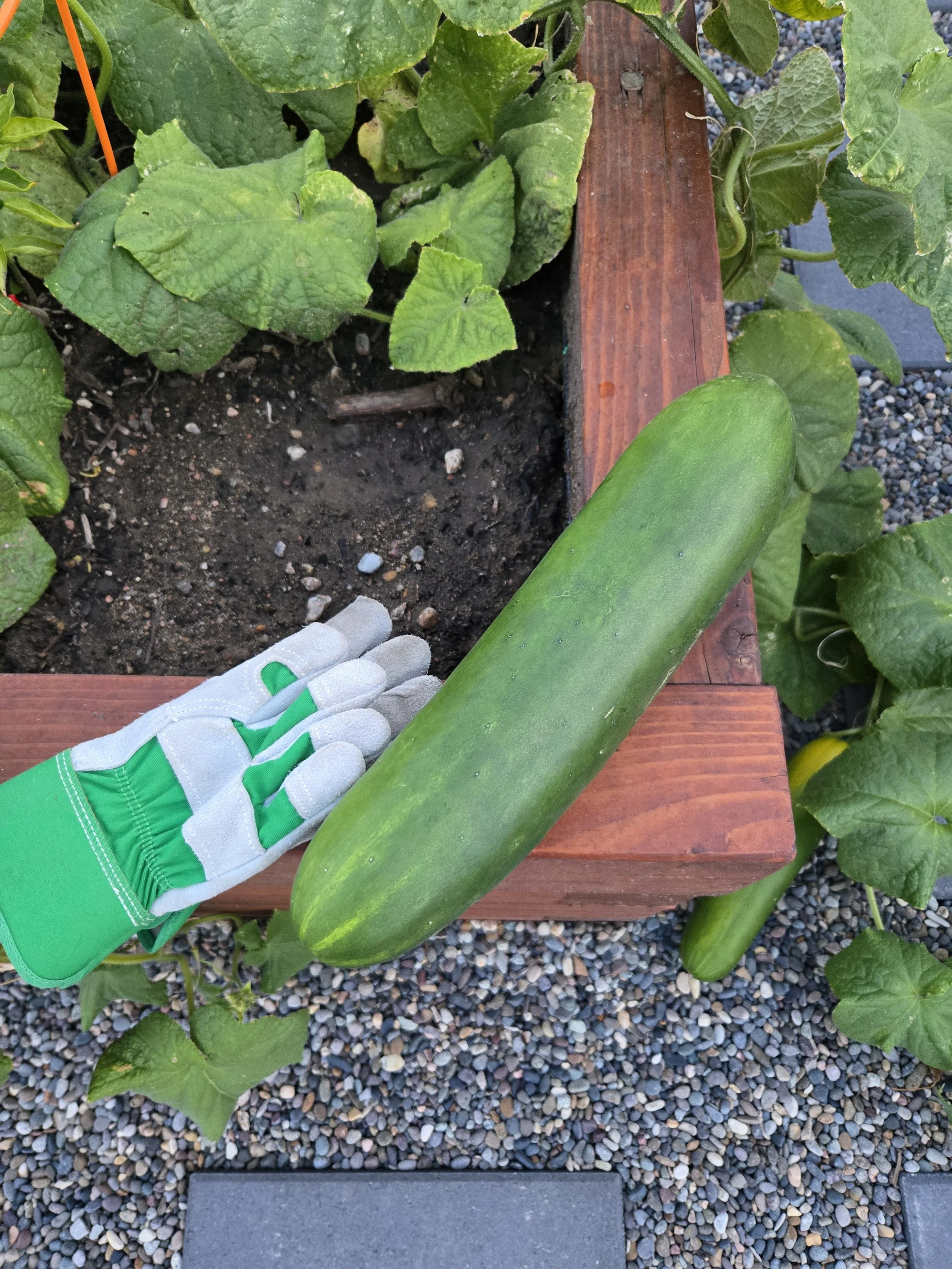
Logo’s Largest Cucumber so far…
The Cucumber Competition
Logo's favorite thing to do in the garden right now is measure the cucumbers . Not just once. Every day. He is determined to grow the biggest cucumber ever. So, when we head outside, he often makes his way to the cucumber plants. He searches through the leaves, finds his biggest cucumber, and measures it. Then, of course, he checks the others.
Has one grown bigger? Did his favorite cucumber get longer? Could this be the one that wins?
It may seem like a simple garden activity, but for Logo, it gives him something familiar and predictable to focus on. Instead of staying stuck in the moment that upset him, his attention gradually shifts. There is a path to walk. There are flowers to look at. There are plants to check. And, most importantly, there are cucumbers that need measuring.
That familiar routine often gives him the time and space he needs to slow down and regulate.
Why the Garden Works for Us
I can't say that the garden magically fixes every difficult moment. It doesn't. But I have seen firsthand how being outside can give Logo an opportunity to step away from an overwhelming situation and focus on something tangible. The garden provides movement without requiring him to "sit still." It offers things to observe without demanding conversation. It gives him familiar routines and activities that he can return to again and again. And it allows him to engage with nature on his own terms.
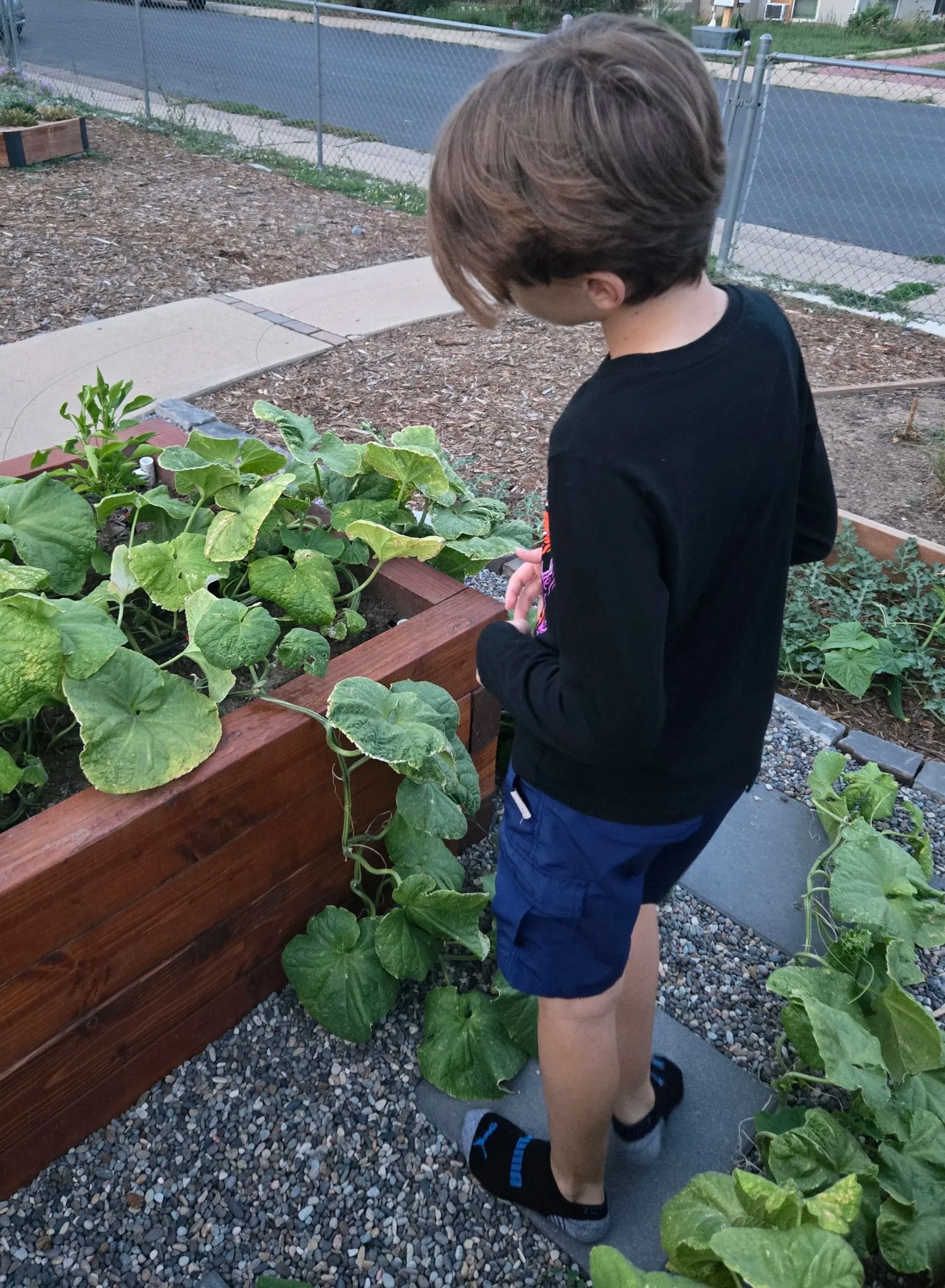
Careful inspection of the garden.
What Does the Research Say?
My experience with Logo is personal, but it is also part of a growing body of research exploring the relationship between nature, gardening, and well-being.
A 2024 umbrella review and meta-analysis examining 40 reviews found an overall positive association between gardening or horticultural activities and measures of well-being, quality of life, and general health. The researchers also cautioned that the studies were diverse, so the findings should not be interpreted as proving that gardening will have the same effect for everyone.
Research specifically focused on autistic children is also encouraging. A 2023 systematic review and meta-analysis in JAMA Network Open examined 24 studies involving 717 children with autism. The authors found that nature-based interventions were associated with short-term improvements in several sensory, social, and behavioral outcomes. Importantly, these interventions included a variety of activities, including horticultural therapy and other outdoor experiences, so the results do not mean that simply having a garden will produce the same outcomes.
More recent research continues to explore this connection. A 2025 scoping review identified 36 studies examining nature and greenness among people with autism, including hands-on gardening and horticulture programs, nearby nature experiences, and wilderness activities. The review also highlights that there is still much to learn about exactly which types of natural environments and activities are most helpful for different individuals.
Research involving children and adolescents more broadly has also found evidence that nature exposure may support attention and cognitive restoration, although findings vary across populations and study designs.
For me, the research is interesting—but the most important evidence is what I see happening right in front of me.
I see a frustrated child walk into the garden.
I watch him begin to slow down.
I see his attention shift from whatever upset him to the bugs, the plants, the path beneath his feet, or the next cucumber waiting to be measured.
Creating a Garden Routine of Your Own
You don't need a large sensory garden to create opportunities for your child to connect with nature. Maybe it's a familiar path through the backyard. A favorite flower to check each day. A container of herbs to touch and smell. A bird feeder to watch. A patch of strawberries to inspect for ripe fruit.
Or perhaps, like Logo, your child might become completely invested in growing the biggest cucumber in the neighborhood.
The key may be finding something that interests your child. Something familiar. Something hands-on. Something they can return to when they need a break.
A garden won't eliminate every difficult moment, and it isn't a replacement for professional support when that support is needed. But for our family, it has become one more tool in Logo's toolbox—a place where he can move, explore, focus, and sometimes find his way back to a calmer place.
One Path, One Flower, One Cucumber at a Time
Our sensory garden began with the idea of creating a space where Logo could explore nature in a way that felt meaningful to him. As the garden continues to grow, so does my understanding of what works for him. And sometimes, the most valuable garden features aren't the ones I carefully planned.
It is a path to walk on, a flower to look at or a cucumber that might—just might—become the biggest one yet.
And on those difficult days, that's enough.
Happy gardening,
Tara
Gardens & Such
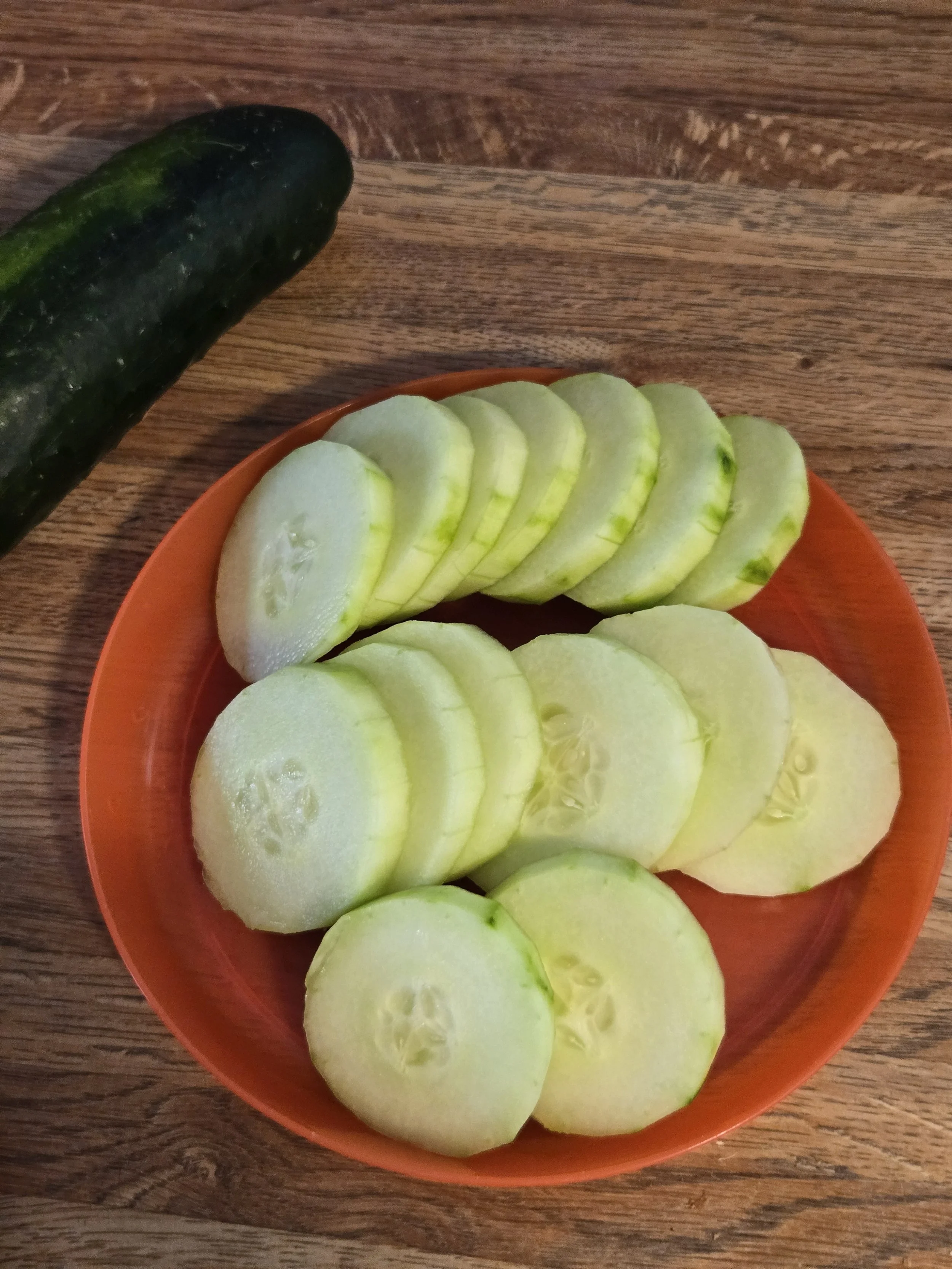
A healthy snack, he will actually eat!
Further Reading
Nature-Based Interventions for Autistic Children: A Systematic Review and Meta-Analysis — A systematic review and meta-analysis of 24 studies involving 717 autistic children.
The Impact of Gardening on Well-Being, Mental Health, and Quality of Life — A 2024 umbrella review and meta-analysis examining the broader evidence around gardening and horticultural activities.
The Effect of the Natural Environment and Greenness Among Individuals With Autism: A Scoping Review — A 2025 review covering gardening, horticulture, nearby nature, and other forms of nature exposure.
Benefits of Nature Exposure on Cognitive Functioning in Children and Adolescents — A systematic review and meta-analysis examining attention, executive function, and cognitive restoration.
Effects of School-Led Greenspace Interventions on Children's Well-Being — A systematic review discussing possible links between nature exposure, attention restoration, and emotional regulation.