Neuro-Conscious Gardening: Creating Spaces That Support the Way We Experience the World

Experience nature through your senses.
When I first started learning more about sensory gardens, I wasn't doing it because I was trying to create a new gardening philosophy. I was doing it because I was trying to understand my child.
As the mother of a child with autism and sensory processing challenges, I had already seen firsthand that the environment around my son “Logo” could make a difference in how he experienced the world. Some places seemed to feel like too much, while others seemed to give him room to slow down, become curious, and engage with what was around him. Our garden became one of those places. That led me to start asking questions about what makes certain outdoor spaces feel inviting, how a garden can provide opportunities for both stimulation and calm, and whether we could create spaces where someone can choose how much—or how little—they want to engage.
Those questions eventually became part of how I think about gardening. Here at Gardens & Such, we are calling it neuro-conscious gardening.
What Is Neuro-Conscious Gardening?
To me, neuro-conscious gardening means thinking about how people experience a garden, not just how the garden looks. Traditional garden design often focuses on questions like what plants to use, what colors work together, or what will bloom throughout the season. Those are all important considerations, but neuro-conscious gardening adds another layer. How does the space feel? What will someone hear? Are there places to move and explore as well as places to retreat? What textures are available? Are there strong smells that might be overwhelming? Is there a predictable path through the space? Most importantly, can someone choose how they want to engage with the garden?
For me, neuro-conscious gardening is about considering the human experience of the garden alongside the horticulture and design. It isn't about creating a garden around a diagnosis or planning a space that works exactly the same way for everyone. It's about recognizing that people experience the world differently and being intentional about building outdoor spaces that offer choices.
And that doesn't just apply to autistic children. It can benefit neuro-divergent individuals of any age, people with sensory sensitivities, children who are still learning how they experience the world, caregivers, siblings, grandparents, and really anyone who finds certain environments more comfortable than others.
Why Sensory Gardens Matter
A sensory garden intentionally creates opportunities to experience nature through our senses. Think about walking through a garden and all of the information you're taking in without necessarily thinking about it. You might hear grasses moving in the wind, smell lavender or basil, feel the texture of a fuzzy leaf, watch butterflies moving between flowers, or taste a strawberry or cucumber you've grown yourself.
Our senses are constantly giving us information about the world around us. For neuro-divergent people, sensory information can sometimes be experienced differently, including heightened or reduced sensitivity to certain sights, sounds, smells, textures, tastes, or other sensations. That's one reason I think sensory gardens can be so interesting. They can provide opportunities to interact with sensory experiences in a familiar environment and, importantly, allow people to choose what they want to explore.
One of the biggest things I've learned through researching sensory gardens is that there isn't one universal "neuro-divergent-friendly" garden. One person might love the sound of wind chimes, while someone else might find them incredibly irritating. One child might want to touch every fuzzy leaf in the garden, while another might avoid certain textures completely. One person might find strong fragrances calming, while another may need a garden with very little scent.
That's why I don't think a sensory garden should simply be a checklist of bright colors, water features, fragrant plants, wind chimes, and interesting textures. Instead, I think about creating options. A garden can have movement and quiet, texture and open space, active areas and places to retreat, fragrance and areas with less scent. The goal isn't to make someone experience everything. The goal is to give them choices. Resources such as the Sensory Trust's guidance on sensory garden design also emphasize creating varied sensory experiences while considering accessibility, individual needs, and different ways people can engage with a garden.
Happy Roots Is Our Real-Life Example
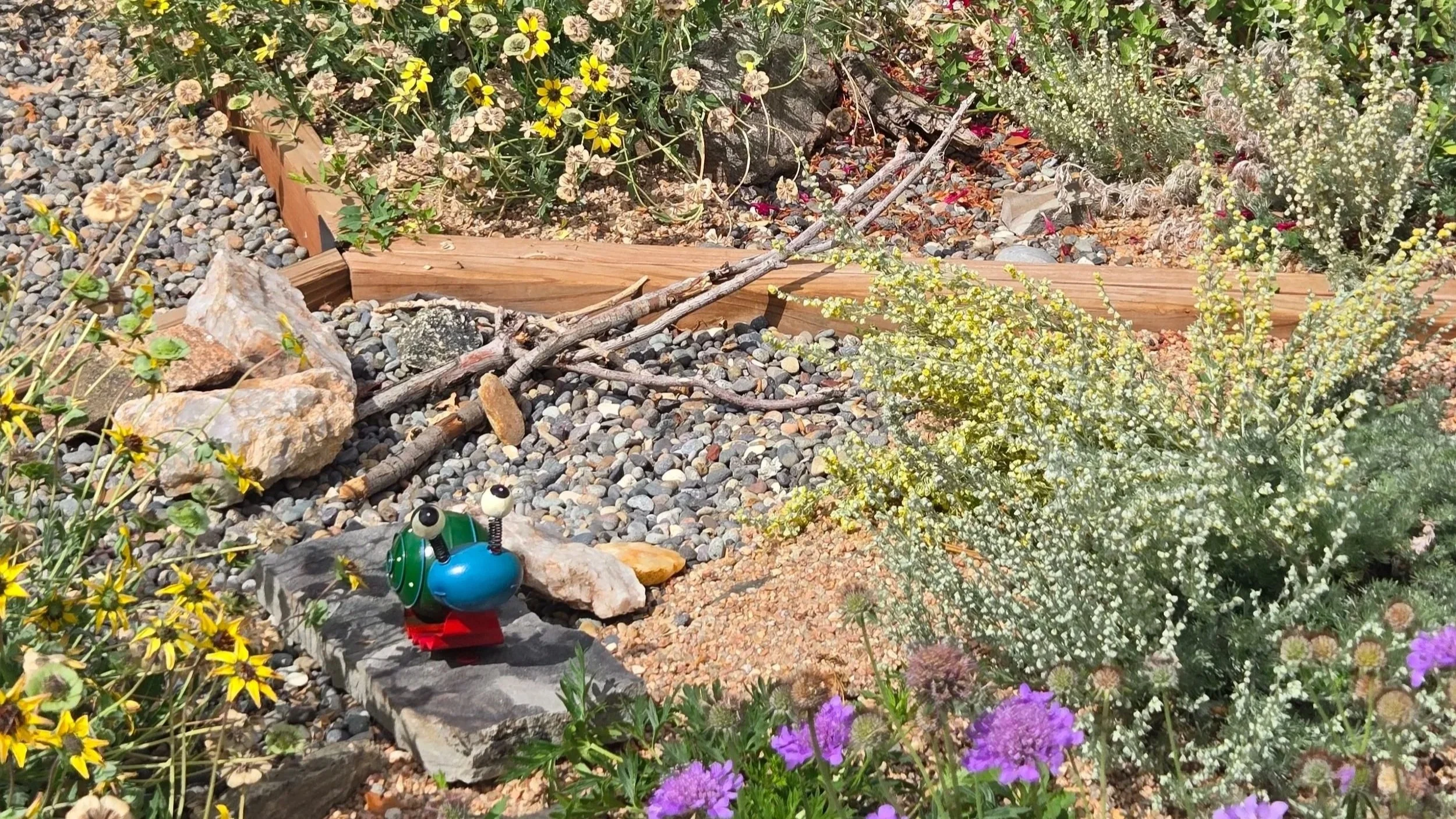
Happy Roots Sensory Garden - Summer 2026
Happy Roots is where a lot of these ideas became real for our family. It started with a simple garden for Logo. He loved dinosaurs, so our original garden became a dinosaur-themed place to play and explore. Over time, that little garden grew into something much bigger. It became a place for gardening, imagination, sensory exploration, growing food, and sometimes simply being outside.
Logo has his favorite things to do in the garden. Measuring cucumbers is currently at the top of that list because he is determined to grow the biggest one. When he's having a difficult moment, the garden can also become one of the tools in his toolbox. He might walk the path, check on the plants, or find something interesting with a bug. It doesn't magically fix every difficult moment, and I would never suggest that a garden replaces professional support. But having a familiar outdoor space where he can move, explore, and engage with things that interest him is valuable for our family.
That's really what I mean when I talk about neuro-conscious gardening. We're paying attention to the person using the garden. We're noticing what captures their attention, what they enjoy, what they avoid, and what seems to help them feel comfortable. We're allowing the garden to become something they can interact with on their own terms.
The Garden Is for Me, Too
The more I learned about sensory gardening, the more I realized something else: I need the garden, too.
As a mom and caregiver, I experience sensory overload, tiredness, frustration, and the general busyness that comes with caring for a family. I can spend so much time thinking about what everyone else needs that it's easy to forget to ask myself what I need.
For me, gardening can be a way of slowing down. I sit with my coffee, pull weeds, water plants, or watch bees move from flower to flower. Sometimes I walk around the garden without accomplishing anything at all. I'm simply noticing what's happening around me.
Research on gardening and horticultural activities has found positive associations with well-being, mental health, and quality of life, although the research varies in quality and design. That doesn't mean gardening is a cure for stress or that stepping into a garden will make every difficult day disappear. But it does reinforce something many gardeners already know: there is something about spending time growing things and being connected to nature that feels good.
For me, Happy Roots has become a place where I can pause and reset. Sometimes it's a few quiet minutes. Sometimes it's getting my hands dirty. Sometimes it's simply standing outside and taking a breath. It doesn't have to be complicated to count as self-care.
A Garden Can Support Different Needs
This is where I think sensory gardens become especially meaningful. A well-designed garden doesn't have to have just one purpose. It can be a place to explore plants, insects, textures, colors, and movement. It can provide opportunities to walk, dig, carry, plant, water, harvest, and work. It can inspire creativity and imagination, create opportunities for family connection, and provide a place to learn about plants, food, and the changing seasons.
It can also be a place to reset when the world feels like too much.
And it can simply be a place to rest.
What I love about the garden is that these experiences don't all have to happen on someone else's schedule. One person might want to spend an hour digging in the soil, while another might want to sit quietly and watch the butterflies. Someone might want to harvest vegetables, while someone else simply wants to walk the path. The garden can meet people where they are that day.
What Does the Research Say?
My interest in this subject started with my own family, but I wanted to understand what researchers were finding, too. There is growing research exploring the relationship between nature, gardening, well-being, and autism.
A 2023 systematic review and meta-analysis published in JAMA Network Open looked at 24 studies involving 717 children and found that nature-based interventions were associated with improvements in several sensory, social, and behavioral outcomes in the short term. The researchers also noted that more robust research is needed, particularly around emotional functioning and subjective well-being.
A 2025 scoping review examining nature and greenness among autistic people identified research covering a variety of natural environments and outcomes related to well-being, behavior, and functioning. The authors also highlighted that this is still a developing area of research.
And while it wasn't specific to autism, a 2024 umbrella review examining gardening and horticultural therapy found generally positive associations with well-being, mental health, and quality of life, while also noting limitations and variation in the existing evidence.
For me, this research doesn't replace what I see in our own garden. Instead, it gives me another way to understand it. It makes me curious about the possibilities and encourages me to keep learning about how we can create outdoor spaces that support different people in different ways.
Neuro-Conscious Doesn't Mean Perfect
I don't believe there is such a thing as a perfectly sensory-friendly garden. People are different, and needs can change from one day to the next. What feels wonderful one day might feel overwhelming another day. That's okay.
A neuro-conscious garden isn't about getting everything "right." It's about being curious. It's about asking who is going to use the space, what they enjoy, what they avoid, where they might go when they need a break, and how they can participate in ways that feel comfortable to them.
It also means allowing the garden to evolve.
Happy Roots certainly has.
It started as a little dinosaur garden. It became a sensory garden. It became a harvest garden. And now it's a place where our whole family can explore, work, rest, learn, and grow.
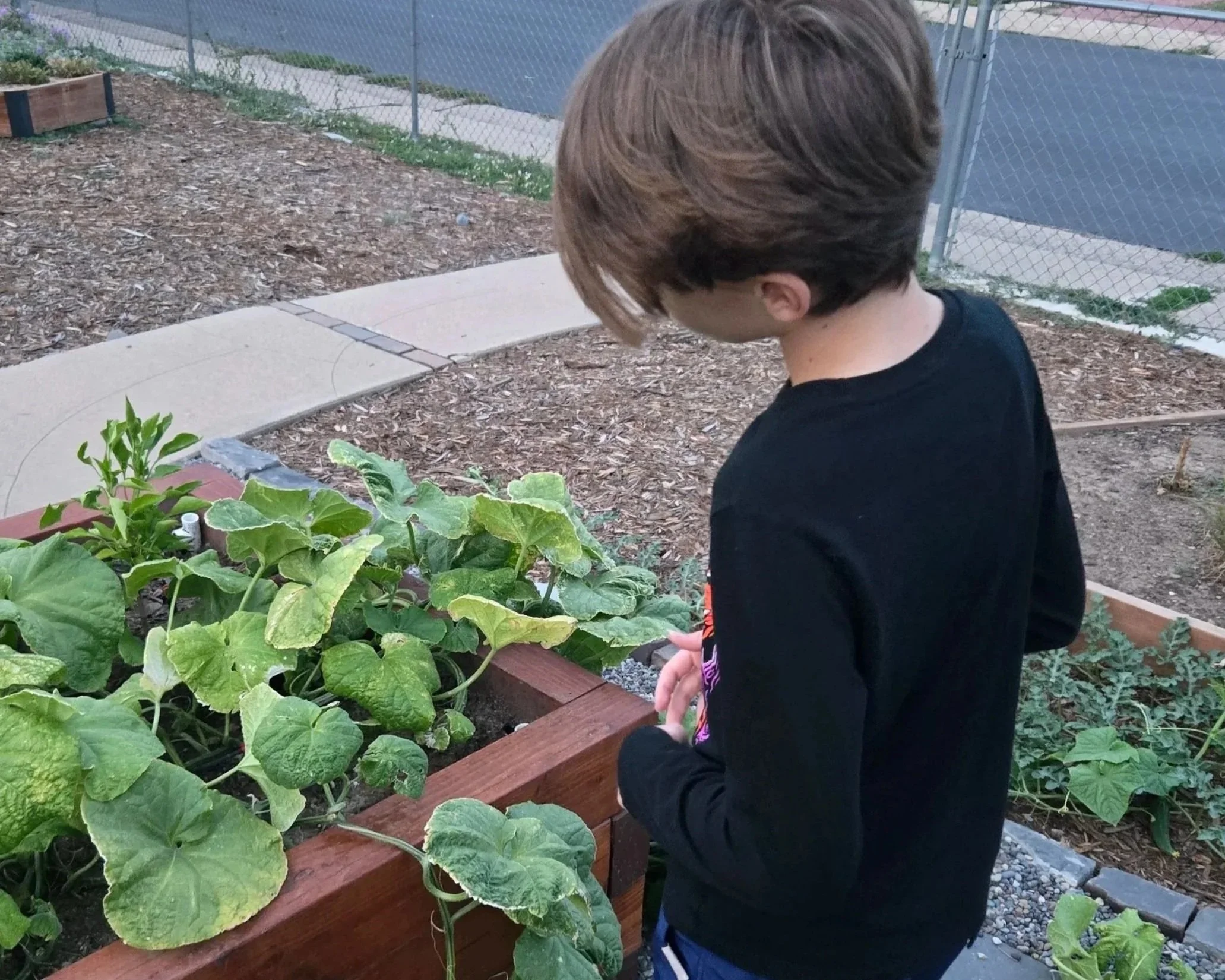
Cucumbers, the only veggie Logo will eat.
Start With the Person, Not the Plant List
That's probably the biggest lesson I've taken from our Happy Roots journey. Before choosing plants, think about the person. Before adding features, think about the experience. Before creating a garden full of stimulation, think about where someone can go when they need less stimulation.
And before trying to create the "perfect" garden, remember that a garden is allowed to change.
That's what neuro-conscious gardening means to me. It's not about designing a garden around a diagnosis or trying to create one formula that works for everyone. It's about recognizing that people experience the world differently and creating outdoor spaces that offer opportunities for connection, comfort, curiosity, and choice.
Because gardens should be more than beautiful.
They can be places to feel, explore, connect, and grow.
Happy gardening,
Tara
Gardens & Such
Explore More
If you're interested in learning more about sensory gardens, nature, autism, and gardening, here are four resources I found helpful as I started exploring these ideas:
1. Nature-Based Interventions for Autistic Children — JAMA Network Open
A systematic review and meta-analysis exploring research on nature-based interventions and outcomes for autistic children.
2. The Impact of Gardening on Well-Being, Mental Health, and Quality of Life — Systematic Reviews
A 2024 umbrella review examining previous research on gardening and horticultural therapy and their relationship with well-being, mental health, and quality of life.
3. The Effect of the Natural Environment and Greenness on People with Autism — Journal of Environmental Psychology
A 2025 scoping review exploring research on nature, greenness, behavior, functioning, and well-being among autistic people.
4. Sensory Trust — Sensory Garden Design Guide
A practical resource exploring how to plan and design sensory gardens with accessibility, individual needs, and varied sensory experiences in mind.
A Note From Tara
Happy Roots and Gardens & Such are about sharing our family's experiences and what I've learned as I continue exploring the relationship between people, plants, and outdoor spaces. A sensory garden isn't a substitute for medical or therapeutic care, and there is no single garden design that will work for everyone. My hope is simply to encourage people to look at gardens a little differently—to think about the people who will use them and create spaces where everyone has opportunities to connect with nature in their own way.